Source: U3A Genealogist Steve Dyer

One of the most crucial skills that you as a genealogist will need to develop is how to weigh up the accuracy of the information presented as evidence before you. Or to put it more simply, how to trust nothing and be paranoid about everything you read!
When trying to form a conclusion about an event that might have affected an ancestor, have you made a completely exhaustive search of all the types of records that might help to reveal potential information about it? Within such records, do you have any conflicting pieces of information, and can you explain the conflict? Can the evidence you are looking at be interpreted in only one way? Are the documents you are consulting primary records, or the most primary form of the record available? For example, most of the censuses we look at online are not primary records, but enumerators’ copies made from household schedules, which were subsequently destroyed. While the enumerators’ returns may now be the most primary form available to us, they may nevertheless still be inaccurate, for example, if they contain transcription errors, or information that might have been ‘standardised’ by the enumerator (such as an occupation). Can you truly make a 100% conclusion based on what you have found?
This does not mean you have to access and explore every possible genealogical record that might be of use in answering your question, this would be pretty impossible given the vast number of sources available. However, that at least two independently-created sources are in agreement, that you have included some primary information, that you have included some original records (i.e. you have looked at an image of a birth certificate instead of just viewing the transcription of that certificate) and that you have used the primary and original documents where these are findable instead of relying on transcriptions or secondary sources which refer to these sources.
It is a sad fact of family history research that there are usually no absolute truths when establishing family relationships (though DNA testing comes close) or discovering what happened to an ancestor. Genealogists have to come to terms with the notion of ‘probability’, i.e. that usually you can only be say 90-95% certain that someone is your ggggrandfather due to inaccuracies in the records, common surnames giving a number of possible matches, possible illegitimacy and so on.
At some point, we all have to accept the most probable answer and move on; that means we have to come to terms with a level of uncertainty that many people are uncomfortable with. However, to get to the point of accepting the most probable answer to a research question, there needs to be a preponderance of evidence supporting that answer.
One of the best ways to establish that you have established proof and reached this level of evidence is to use the Genealogical Proof Standard used by both the American and British Societies of Genealogists
- Research has been reasonably exhaustive
- Information has been analysed and correlated
- Conflicting evidence has been resolved
- Sources have been cited or referenced
- A reasoned conclusion has been created
If you follow the above tenets of Genealogical Proof you’ll find it much easier to have a solid batch of research that stands the test of time!
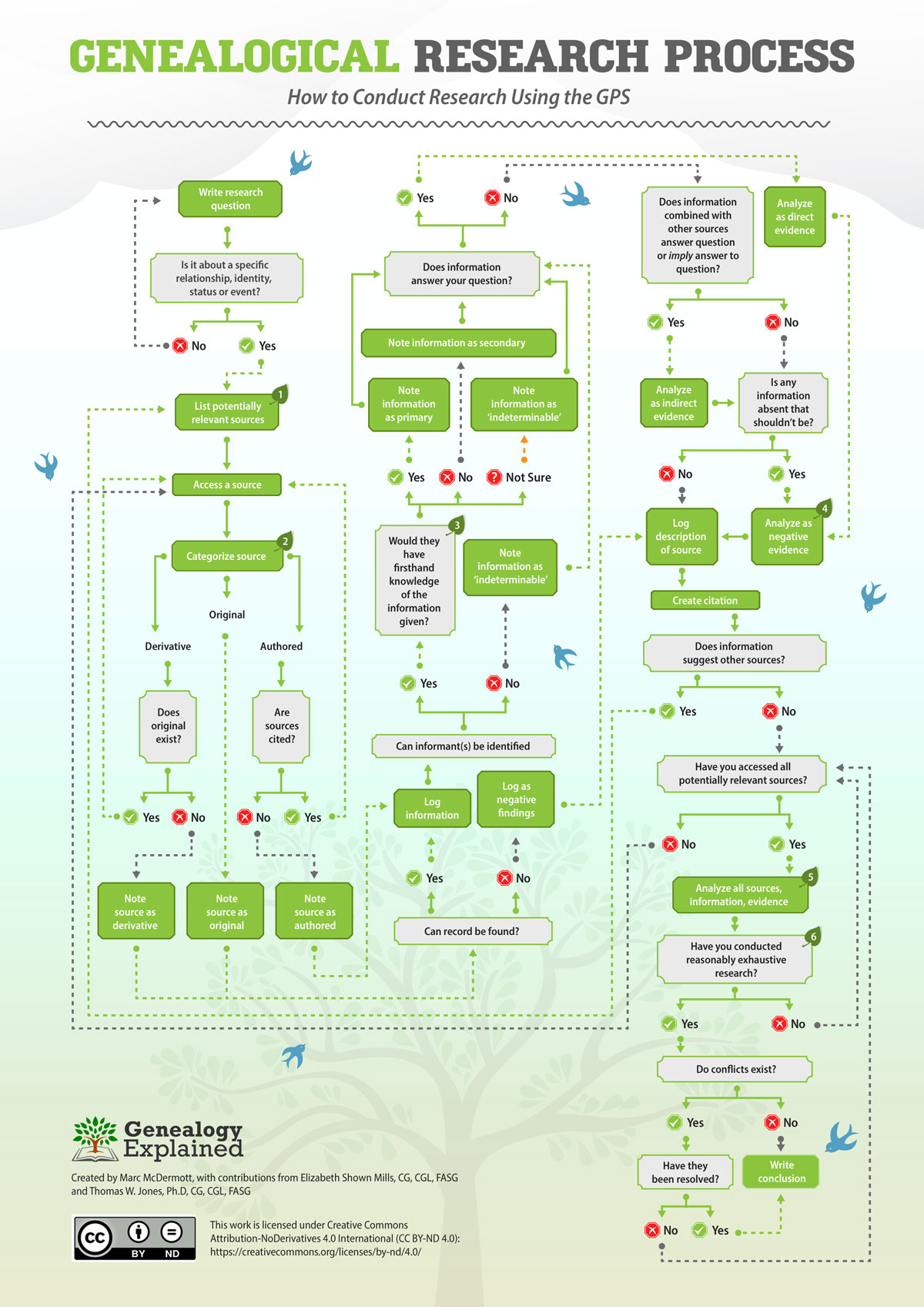 The Genealogical Proof Standard (GPS) was created by the Board for Certification of Genealogists. It’s used to create sound, credible genealogical proof statements, and gives genealogists a standard to measure conclusions against.

